
Restaurant Website Design with an Online Ordering System
You work day and night, and then the delivery app takes a third of your profit from every order—and since it owns your customers, you don’t even know who ordered from you. A restau...
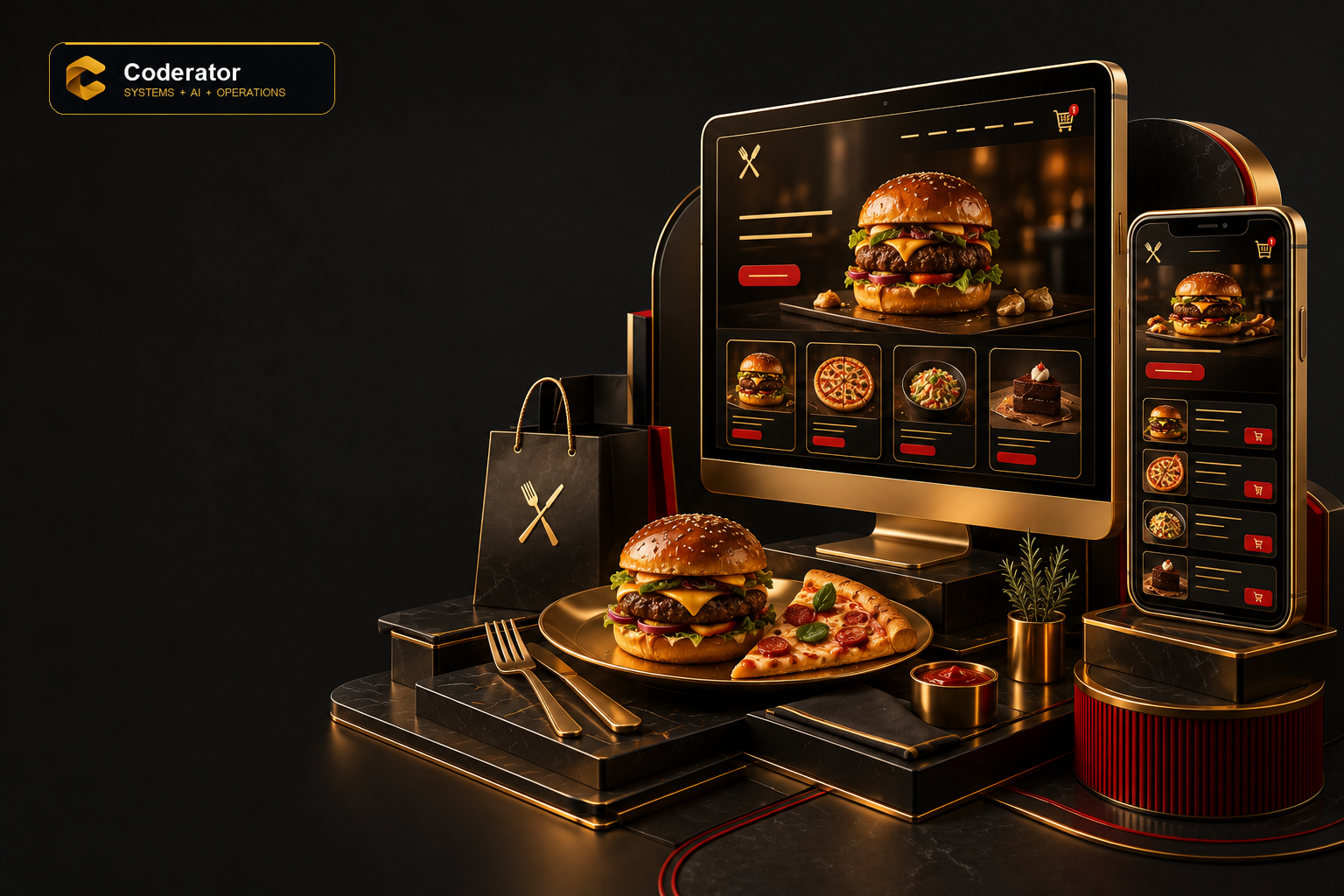
You run your restaurant with passion, working day and night to ensure the quality of your food and service, and then a delivery app comes along and takes a commission on every order—sometimes as much as a third of its value—and you pay it with a smile because it brings you customers. But what’s more dangerous than the commission is something you don’t notice: this app owns your customer, not you. You don’t know their name, their phone number, or what they like, and you can’t reach out to them or win them back—they’re the “app’s customer,” not your restaurant’s. And if the app decides to raise its commission or change its rules, you’re at its mercy with no choice in the matter. Herein lies the difference that most “restaurant website” providers overlook: A website with a proprietary ordering system isn’t just a sleek interface—it’s your direct channel that frees you from the crippling commission and gives you back ownership of your customers, their data, and your profits. A digitally successful restaurant doesn’t just rely on third-party apps—it builds and owns its own channel.
In this guide, we’ll show you exactly what your restaurant needs: Why a direct channel frees you from commissions, how to define your restaurant’s model, how the ordering system and digital menu work, how orders reach the kitchen accurately, how to retain and win back customers, and how artificial intelligence can help you — and how we build all of that into Coderator.
1. Who is Coderator? And why do we build restaurant websites differently?
Coderator is a software company specializing in building advanced business systems and integrating artificial intelligence into real-world operating environments. We operate from our offices in Giza and Riyadh to serve companies in the Middle East and North Africa. We treat your restaurant’s website as your direct ordering channel—one that frees you from intermediary commissions and brings your customers back to you—not just a promotional interface. That’s why we start with the reality of your restaurant: How do you receive orders? How much do you pay to third-party apps? And how do orders reach your kitchen? Then we build a system that supports your operations—with direct, commission-free orders, a direct connection to your kitchen, and full ownership of your customers and their data. Most importantly: the code and your customer base are entirely yours, so you’re not held hostage by an app that owns your customers, takes a third of your profits, and controls the fate of your restaurant’s online presence.
2. The Killing Commission vs. the Direct Channel
Food delivery apps (Talab, Uber Eats, and the like) are a great way to attract new customers, but they come at a cost that breaks the bank for restaurants: a commission that often ranges from one-fifth to one-third of each order’s value. In an industry with already slim profit margins, this commission can mean that a restaurant is barely breaking even or actually losing money on online orders. Worse still, these apps monopolize the relationship with the customer: the customer orders from the “app,” not from “your restaurant,” and the app retains their data and doesn’t share it with you, so you can’t get to know your customers, reach out to them, or build their loyalty—in fact, the app might even feature competing restaurants near you and steer your customers toward them.
This is where the power of the direct channel comes in. When a customer orders directly from your restaurant’s website, you keep the full value of the order without paying a middleman’s commission, you own your customer’s data so you can reach out to them and bring them back, and you control their experience and your offers. The key isn’t to abandon delivery apps entirely (they do bring in new customers), but to build your direct channel so you can gradually shift your repeat customers to it—a customer who has tried your food through the app once can be encouraged to order directly from you on subsequent visits, without any commission. A restaurant website with an ordering system is therefore not a luxury, but a financial decision that brings your profits and customers back to you. We build it because it is precisely what frees your restaurant from dependence.
3. What kind of restaurant are you? (The model determines the system)
“Restaurant website” is an umbrella term that encompasses different operating models, each with its own specific needs. Anyone who offers the same one-size-fits-all solution ignores the nature of your operations:
We’ll start by meeting with you to determine your restaurant model (or a combination of models), so we can build the right system — A delivery-only restaurant relies on an ordering system and delivery zones; a dine-in restaurant needs a QR menu and table ordering; and a chain requires branch management. They cannot all be built the same way.
4. The Digital Menu and Ordering Experience
The menu is the heart of the restaurant’s website, and how it’s presented makes the difference between a visitor who orders and one who leaves hungry to look elsewhere. Food is bought with the eyes, so a successful digital menu is visually appealing and enticing: High-quality, appetizing photos of every dish (a good photo actually boosts orders), descriptions that whet the appetite with details about ingredients, and a clear organization into sections (appetizers, main courses, drinks, desserts) that makes browsing easy. We make the ordering process smooth and intuitive: adding a dish to the cart with a single tap, customizing the order (no onions, add cheese, doneness level), selecting sides and portion sizes, and clearly displaying the price.
We also add features that increase order value: suggesting add-ons and complementary items (a drink with the meal, dessert afterward)—a practice known as upselling that raises the average check—and featuring “Most Popular” and “Today’s Specials” to guide customers. A clear shopping cart that displays the order and total before confirmation, and a checkout process with as few steps as possible—including the option to order as a guest without mandatory registration (every extra step risks losing a hungry, impatient customer). A sleek, attractive digital menu isn’t just for show—it’s your digital restaurant’s primary sales tool, and we build it to entice customers to order and make the process as easy as possible.
5. Ordering System (Delivery, Takeout, Dine-In)
This is the engine of the website that turns browsing into actual orders and revenue. We build it to flexibly support the ordering models your restaurant needs:
- Delivery: Specify the address, delivery area and fees, minimum order amount, and estimated delivery time.
- Takeout / Pickup: Select the location and pickup time, and notify the customer when their order is ready.
- Table Ordering (Dine-in): Scan the QR code on the table and order directly without waiting for a server.
- Scheduled Order: Reserve an order for a later time (important for events and parties).
- Instant order confirmation and status notifications (being prepared, on the way, ready, completed).
- Track the delivery order and estimated arrival time, so the customer can rest assured and doesn’t have to call repeatedly.
- Real-time order status connects the customer to the kitchen and delivery in a single experience.
- Reorder a previous order with a single tap to make it easy for regular customers to repeat their orders.
We build the ordering system to fit your operational style, and it runs smoothly under peak-time pressure (when orders come flooding in) without a hitch—because if an order gets lost or delayed during peak hours, your restaurant loses a customer.
6. Kitchen Integration (KDS Screen)
This is the crucial point that those selling you a “website” often overlook: online ordering is worthless if orders don’t reach the kitchen correctly and quickly. Relying on paper printouts or manually relaying orders creates chaos, errors, and delays, especially during peak hours. That’s why we connect the ordering system directly to the kitchen display system (KDS): As soon as an order is confirmed, it appears on the screen in front of the chefs with clear details and customizations, organized by priority and time, and the staff updates its status (preparation started, ready), which is automatically reflected to the customer.
This integration eliminates order transmission errors (wrong dish, forgotten customization), speeds up preparation, reduces chaos in the kitchen during peak hours, and consolidates orders from all channels (website, table, and apps, if integrated) onto a single screen in front of the chefs. The difference between a restaurant that receives online orders and integrates them into its operations and one that leaves them isolated is the difference between a system that works and chaos that frustrates both customers and staff. We build this integration because a true ordering system extends from the customer’s screen to your kitchen—it doesn’t stop at the “Order” button.
7. Customer Acquisition and Retention
This is the treasure that delivery apps take away from you, but the direct channel gives it back to you. When a customer orders from your website, you own their data: their name, phone number, address, order history, and preferences. This data is a valuable asset with which you can build a lasting relationship instead of a one-time sale. We build tools for customer acquisition and retention: a customer database with their order history and preferences, a loyalty program and points system that rewards repeat customers and encourages them to return, targeted offers and coupons sent directly to your customers, and a system that reminds and encourages customers to order again.
The difference is fundamental: on a delivery app, your customer is anonymous, and you pay a commission to reach them every time. On your direct channel, your customer is known, and you can reach them for free whenever you want. Retaining an existing customer is much cheaper than attracting a new one, and a restaurant that builds a base of loyal customers who order directly from it builds a sustainable business that doesn’t depend on a middleman controlling its fate. We build tools for you that turn every direct order into the start of a relationship, and every customer into a loyal one—and that alone justifies building your own channel.
8. Dashboard and Restaurant Management
Behind the website is a control panel that lets you easily manage your digital restaurant. We build it in clear, easy-to-understand Arabic to cover all aspects of your operations:
- Manage the menu, items, prices, photos, and add-ons yourself at any time.
- Hide a sold-out item or temporarily pause ordering with a single click.
- Manage incoming orders and their statuses from all channels in one place.
- Manage promotions, coupons, packages, and minimum order amounts.
- Manage branches, delivery areas, delivery fees, and business hours (for chains).
- Customer database, loyalty program, and targeted offers.
- Sales reports: best-selling items, peak times, average check, and branch performance.
- Team permissions (cashier, kitchen, management), and integration with delivery and payment systems.
We design the dashboard specifically for restaurant operations, allowing you to efficiently manage your menu, orders, branches, and customers, and analyze your data (e.g., which items are selling? When are peak times?) to make smart decisions and increase your profits.
9. Payment, Delivery, and Branches
The ordering experience is completed by payment and delivery, and we take into account the specific considerations these entail for restaurants. We integrate the platform with payment methods suitable for your market: electronic payments (cards, digital wallets), and—most importantly in our market—cash on delivery, which many restaurant customers prefer. For delivery, we build a flexible management system: defining delivery zones and fees for each zone, setting minimum order amounts, managing your restaurant’s own delivery drivers or integrating with a delivery service, and tracking orders. For chains: Manage multiple locations with their respective areas, menus, and prices, automatically routing customer orders to the nearest or most appropriate location for their area.
These elements make the ordering system function as an integrated operating system—not just an order form. Customers pay in the way that’s most convenient for them, orders go to the correct branch, and they’re delivered by the appropriate driver—all while you manage everything from a single location. We build this system to fit the size and model of your restaurant, from a single branch delivering to its local area to a chain of branches efficiently managing their unified delivery operations.
10. Artificial Intelligence in Restaurants
This is where we truly excel—artificial intelligence in restaurants directly drives sales and efficiency:
We’ve built it to actually boost your sales and improve your efficiency, while ensuring that your customer and restaurant data isn’t leaked into general training models. Note that the order-taking chatbot alone can save you on staffing costs and capture orders you would otherwise lose outside of business hours.
11. Off-the-shelf solution or custom development? (When you don’t need a custom system)
Here, we’ll tell you what those trying to sell you the most expensive solution always leave out. The decision depends on your size and ambitions:
- An off-the-shelf solution (a subscription-based ordering system or a ready-made platform) may be sufficient if you’re a small, single-location restaurant that wants a basic ordering channel quickly and at a low startup cost, and you don’t mind a monthly subscription fee and customization limits, without multiple locations or complex integrations.
- Custom development becomes more cost-effective and powerful as you grow (multiple locations, high order volume), or if you want complete freedom from commissions and subscriptions, or integration with your kitchen and systems (KDS, POS), or a unique brand identity and experience, or full ownership of your customers and their data without a subscription that grows as you do.
We wouldn’t recommend a custom system if you’re a small restaurant just starting out—a simpler solution that saves you money now and validates the concept of direct ordering might be enough. But as your restaurant grows and accumulated commissions, subscription fees, and ownership of your customers become the core of your profits, custom software is an investment you own—one that grows with you without any commission deducted from every order, ever. We’ll honestly help you make the right decision for your size.
12. Cost and Approach
The cost of a restaurant website with an ordering system varies depending on your restaurant model, the number of locations, order types (delivery, takeout, dine-in), the level of integration (KDS, payment, delivery), and the AI components. Therefore, it’s not accurate to give a final figure before understanding your restaurant, and anyone who gives you an immediate price without asking questions is selling you a template—not a solution—for your operations. We start by understanding your business model and scope, then we develop a clear roadmap for costs and phases—and we often recommend starting with the core ordering channel that frees you from commissions first, then expanding.
Our methodology results in a system that works under the pressures of a real restaurant: a discovery session where we define your business model, ordering patterns, and operations; followed by designing a menu and an ordering experience that’s both appealing and seamless; building the ordering system and integrating it with the kitchen, payment, and delivery; conducting thorough testing (especially under peak-hour pressure) before launch; and finally, training your staff and providing ongoing support after launch. We build a direct ordering channel that frees you from commissions and brings your customers back to you, then we scale it as your restaurant grows.