
Human Resources (HR) Management System Programming
Off-the-shelf HR systems may seem similar, but their most complex aspects—payroll and compliance—vary from country to country and company to company, and the administrative burden...
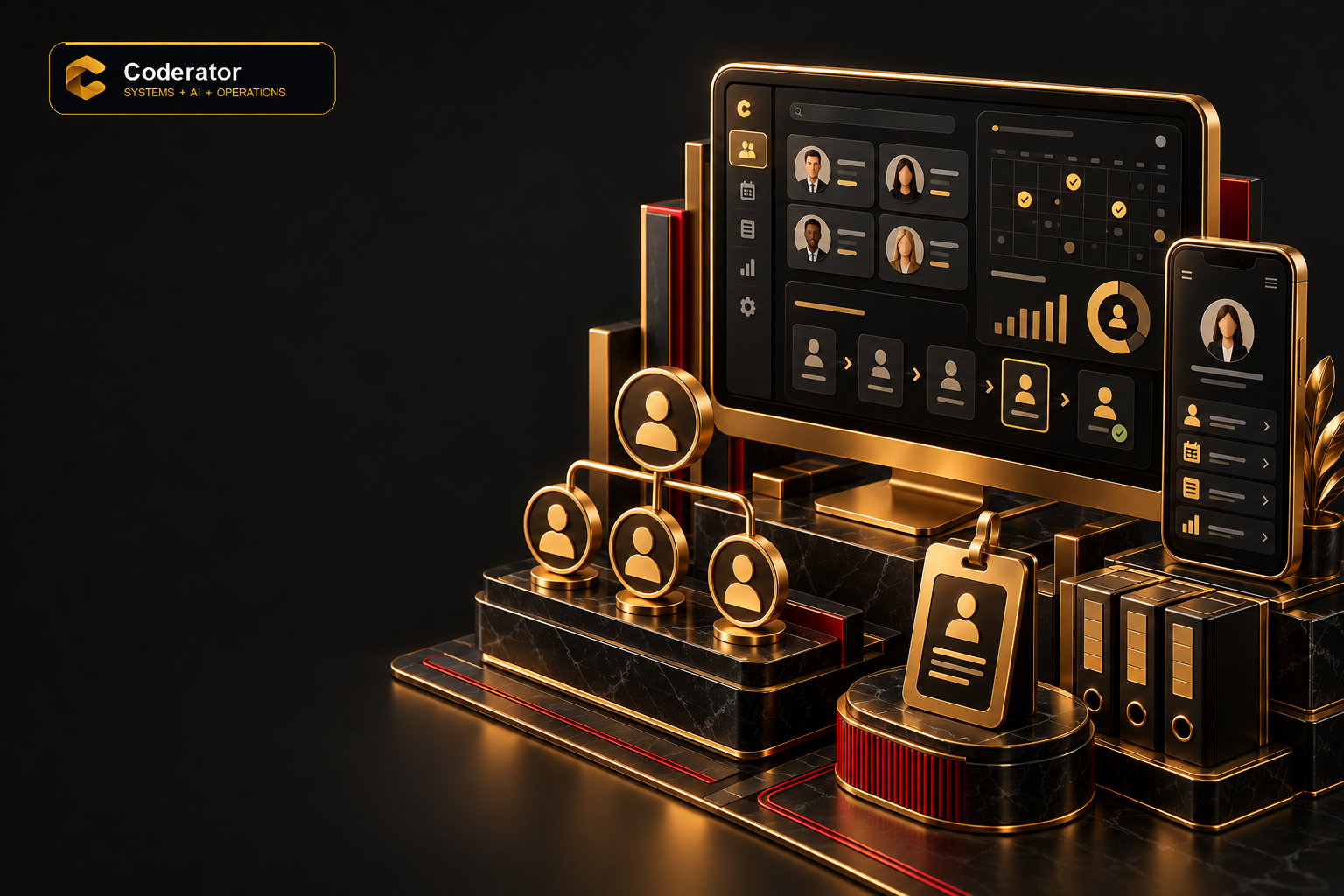
Human resources management systems all seem to be the same: clock-in and clock-out, payroll, leave, reports, and employee self-service. If you look for any off-the-shelf system, you’ll find the same list repeated over and over. But beneath this superficial similarity lies the most complex and sensitive aspect of human resources: payroll and compliance. Payroll calculation isn’t simply adding up a fixed amount; it’s a complex system of allowances, deductions, advances, commissions, overtime, taxes, social insurance, and end-of-service benefits — all of which vary from country to country depending on local labor laws, and from company to company depending on their specific policies. This is where many off-the-shelf systems fail: they’re built for a general model or a specific country, and when your laws or policies differ from them, you find yourself fighting the system or forcing your company to change its ways. Added to this is a pitfall that many overlook: the subscription cost for these systems is calculated per employee, so as your team grows, it can balloon into huge annual amounts. A successful HR system is built around your laws and policies, and you own it without exorbitant subscription fees.
In this guide, we provide you with what your company truly needs: What an HR system is, when you need it, why payroll and compliance are more complex than they seem, the real difference between off-the-shelf and custom solutions (and the subscription trap), what system modules consist of, how it’s built around your policies and integrates with your systems, how artificial intelligence can help you—and how we build all of that into Coderator.
1. Who is Coderator? And why do we build HR systems differently?
Coderator is a software company specializing in building advanced business systems and integrating artificial intelligence into real-world operating environments. We operate from our offices in Giza and Riyadh to serve companies in the Middle East, North Africa, and beyond. We treat the HR system as a system that manages your most important assets (your employees) and handles your most complex processes (payroll and compliance)—not as an off-the-shelf product we sell to you. That’s why we don’t start with a list of features—we start with your company’s reality: What are the labor and tax laws in your country? What are your specific policies on salaries, allowances, and incentives? How do your shifts and leave policies work? Then we build a system tailored specifically to these needs, or we’ll honestly recommend a ready-made solution if that’s the best fit for you. Most importantly: the code and your employees’ data are entirely yours—so you’re not held hostage by a provider that charges a subscription fee per employee that balloon as you grow and locks up your most sensitive data—your employees’ salaries and personal information.
2. What Is an HR System, and When Do You Need It?
A Human Resources (HR) management system is a system that manages everything related to your employees in one place: their data and files, their clock-ins and clock-outs, their leave, their payroll, their performance, and their onboarding. Instead of managing these processes manually in scattered Excel files—which leads to payroll errors, lost attendance records, and delayed transactions—the system consolidates and automates them. The need for it becomes apparent as your team grows: manual payroll calculations take days and are prone to costly errors; attendance and leave records become chaotic; tracking and reporting become difficult; and compliance is hard to manage manually.
A good system saves the HR team time (by automating calculations and transactions), reduces costly payroll errors, ensures compliance, and gives management clear visibility into the workforce. However, not every company needs a system; a very small company with just a few employees may find that a well-organized spreadsheet is sufficient. Practical Tip: When payroll, attendance, and leave management become a costly, error-prone manual burden, you’ve earned a system—whether off-the-shelf or custom-built—and we’ll help you determine which is right for you.
3. Payroll and Compliance: More Complex Than It Seems (The Core of the Challenge)
This is the heart of an HR system and its most difficult aspect—and it’s often overlooked when people list the benefits. Calculating a single employee’s paycheck isn’t just adding up numbers; it’s a multi-layered equation: base salary, allowances (housing, transportation, job-related), incentives and commissions (which may be calculated using company-specific formulas), overtime, and deductions (for tardiness, absences, or penalties), advances and their deductions, income taxes, social insurance, and end-of-service benefits. Each of these layers is subject to fundamentally different rules:
- They vary from one country to another: Labor laws, tax laws, social insurance regulations, and end-of-service benefits differ radically from one country to another, so a system designed for a specific country may not be suitable for yours.
- They vary from one company to another: Every company has its own policies regarding allowances, incentives, commission calculations, and penalties, which may be complex or unique.
- They change over time: Tax laws and insurance rates change, and the system must keep pace with them.
- They leave no room for error: An error in an employee’s paycheck (underpayment or overpayment) can lead to a dispute with the employee, a financial loss for the company, or a legal violation.
This is where many off-the-shelf systems fail: they use a generic or country-specific template, so when your laws or policies differ from them, you’re forced to adapt your company to fit or make costly modifications. A custom system is built specifically around your country’s laws and your company’s policies, so it calculates your payroll accurately as it actually is—not as a generic system assumes it should be. Payroll and compliance are the true test of an HR system, and we build them with precision because they are the core of its value—and the point where a solution that doesn’t fit your reality falls short.
4. Off-the-shelf or Custom? And the “per-employee subscription” trap
This is a fundamental decision, and we trust your judgment on it. Each approach has its merits:
- is right for you if your processes are standard, your country’s laws are supported within it, and your policies are simple.
- It’s faster to get started and proven—but the subscription fee is often calculated on a per-employee basis.
- The downside: It may not support your country’s laws or your specific policies, and customizing it can be costly or impossible.
- Vendor lock-in: Your employees’ data and payroll are locked into the system, making it difficult to switch.
- Built specifically around your country’s laws and your company’s policies, it calculates your payroll exactly as it should be.
- Full ownership of the code and data, with no per-employee subscription fees that increase as your team grows.
- It includes only what you need and integrates seamlessly with your systems and devices.
- It adapts to changes in your laws and policies as you see fit, without having to wait for the provider.
Here’s a trap many overlook: per-employee subscriptions. Off-the-shelf systems seem cheap at first, but they charge you monthly per employee—so as your team grows, so does your bill. A company with hundreds of employees could end up paying massive annual sums that keep piling up, whereas a custom system is a one-time investment that you own and can use for any number of employees without per-employee fees. The rule of thumb: Off-the-shelf solutions are best for small teams with standard processes and supported regulations, while custom solutions are more cost-effective for large teams, those with specific policies, or those with unsupported regulations. We’ll honestly help you make the right decision—and if an off-the-shelf solution is the best fit, we’ll tell you so.
5. Human Resources System Modules
The HR system is modular, allowing you to build only what you need. Its most important modules are:
Modules can be added as needed (training, onboarding, end-of-service, workforce planning). The key advantage is that each module is built to fit your operations, includes only what you need, and integrates into a unified system (for example, attendance data automatically feeds into payroll). We build what truly serves your company without unnecessary modules that complicate usage.
6. The system is built around your policies, not the other way around
This is the essence of a custom system’s superiority. Every company has its own way of doing things: specific leave policies, complex shift schedules (for factories, hospitals, and restaurants), unique incentive and commission formulas, specific managerial approval workflows, and allowances and penalties with their own rules. Off-the-shelf systems are based on a generic model of how “any company” operates, so when your policies differ from that model, you’re forced to either change your ways to fit it (which leads to resistance and frustration) or make costly modifications. A custom system flips the equation: it’s built around your actual policies, so it works exactly the way your company does.
We always start by understanding your policies: How do you calculate incentives? How do you manage shift schedules? What is the approval workflow? How do you handle tardiness and absences? Then we build a system that accurately implements these policies. This is doubly important in human resources because its policies are precise and sensitive (they affect employees’ pay and rights), and any mismatch between the system and your policies means payroll errors or administrative confusion. We build the system around your approach because that’s what ensures it truly serves your company, rather than imposing a one-size-fits-all model—something a generic template, no matter how many features it has, simply cannot provide.
7. Attendance and Integration with Devices
Attendance is the foundation of payroll accuracy (work hours, tardiness, and overtime are reflected in pay), so integration with time-tracking devices is crucial. We build a system that supports multiple attendance methods: fingerprint or facial recognition devices, which are common in companies; mobile app check-in with geolocation (for field employees or remote workers); web-based check-in; and QR codes. We integrate with your existing fingerprint devices so that attendance data is automatically transferred to the system without manual entry.
This integration directly improves payroll accuracy: actual working hours, late arrivals, and overtime are calculated from attendance data and automatically reflected in payroll, eliminating manual entry errors and complex calculations. We build attendance systems to integrate with your devices and your workflow (office-based, field, and remote employees), because accurate attendance is the foundation of accurate payroll — and the link between attendance and payroll is one of the most important factors in saving your team time and preventing errors.
8. Self-Service and Employee Experience
Employee self-service transforms HR from a department overwhelmed with requests into a system that serves employees directly. We build an employee portal or app where employees can view their data without going through HR: their pay stubs and details, vacation balance, request for vacation, leave, and advances electronically and track their approval status, update their information, and upload their documents and certificates. This benefits both parties: employees get what they need immediately without waiting, and the HR team is freed from repetitive, routine requests to focus on more important tasks.
A positive employee experience is key to their satisfaction and productivity: An employee who finds a user-friendly system that serves their needs (clear pay stubs, one-click leave requests, transparency in their data) feels that their company is professional and values them. A system that automates requests and approvals speeds up transactions and reduces paperwork and errors. We build self-service solutions because they boost both HR efficiency and employee satisfaction, transforming the system from a mere management tool into a service for every employee in the company.
9. Integration with Your Systems
The most powerful HR system is not an isolated island but part of your company’s ecosystem. We build it to integrate with your systems: Integration with your accounting or ERP system so that payroll and expenses are automatically posted to financial entries without double entry; integration with fingerprint and time-and-attendance devices; integration with payment systems for payroll disbursement; and integration with other systems specific to your company. Integration makes HR part of the company’s complete financial and operational picture, rather than a standalone system that requires manual data transfer.
Integration with accounting, in particular, is crucial: Salaries are often the largest monthly expense, and automatically transferring them to the financial system saves time, prevents double-entry errors, and provides an accurate, real-time financial picture. We build seamless integrations that allow the HR system to operate within your ecosystem, because its value is realized when it is connected to your systems, not isolated from them.
10. Artificial Intelligence in Human Resources
This is where we truly excel; artificial intelligence transforms HR from a paper-based process into a smart system:
This is where we stand out: AI in HR starts with the process and the return on investment, not the technology itself, and we implement it where it actually saves your team time and improves your decisions. Most importantly, in a system that manages your employees’ payroll and personal data: your data remains in a secure environment and is not leaked to public training models.
11. Security and Ownership of Your Employees’ Data
An HR system holds a company’s most sensitive data: employee salaries and personal information (IDs, addresses, bank accounts, performance reviews). This is highly sensitive data; its leakage constitutes a violation of your employees’ privacy and poses legal and administrative problems. Therefore, its security and ownership are critical factors. We build your system on strict security foundations: Data encryption (especially for salaries), very precise access controls (each employee sees only their own data, managers see their teams, and the finance department sees what pertains to them), a log of every operation for accountability, and secure backups. Most importantly—full ownership: the code and your employees’ data belong solely to you; you host them wherever you choose, without being locked into a provider that owns your employees’ payroll data.
This is a particularly sensitive issue in human resources: payroll data is confidential (employees don’t like their salaries to be disclosed), and their personal data is private and must be protected. With off-the-shelf systems, this data resides on the provider’s servers and is subject to their policies. With a custom solution, you own it entirely and control its security as you see fit. We carefully build in security and granular permissions because an HR system holds secrets that affect every employee, and protecting them is a red line.
12. Cost and Methodology
The cost of an HR system varies depending on the number of departments, the complexity of your policies (especially regarding payroll and shifts), your country’s laws, the scope of integration, the number of employees, and the AI components. Therefore, it’s not appropriate to give a definitive figure before understanding your operations, and anyone who gives you an immediate price without a thorough review may be selling you a system that doesn’t comply with your country’s laws. However, we’d like to highlight an important comparison: an off-the-shelf system may seem cheaper, but it involves a per-employee subscription fee that accumulates and increases as your team grows, whereas a custom-built system is a one-time investment that you own for any number of employees. We start with a discovery session to understand your policies and regulations, then outline the scope, cost, and phases—and we recommend starting with the most critical modules (payroll and attendance) before expanding.
Our methodology takes the sensitivity of human resources into account: a discovery session where we thoroughly understand your policies, your country’s laws, and your payroll system (the most important step), followed by designing the system around your policies, meticulously building the payroll and attendance modules (with zero margin for error) while planning for integration, followed by thorough testing—especially for payroll (we test real-world scenarios)—before launch, then training your team, and finally, launch and ongoing support. We start with your policies and laws, and we ensure payroll accuracy—because that is the essence of a successful HR system.