
Design of a Digital Wallet and Electronic Payment App (FinTech)
Building a financial app isn’t like building just any app: You’re dealing with people’s money and trust, and you’re under the supervision of the central bank. Its success doesn’t s...
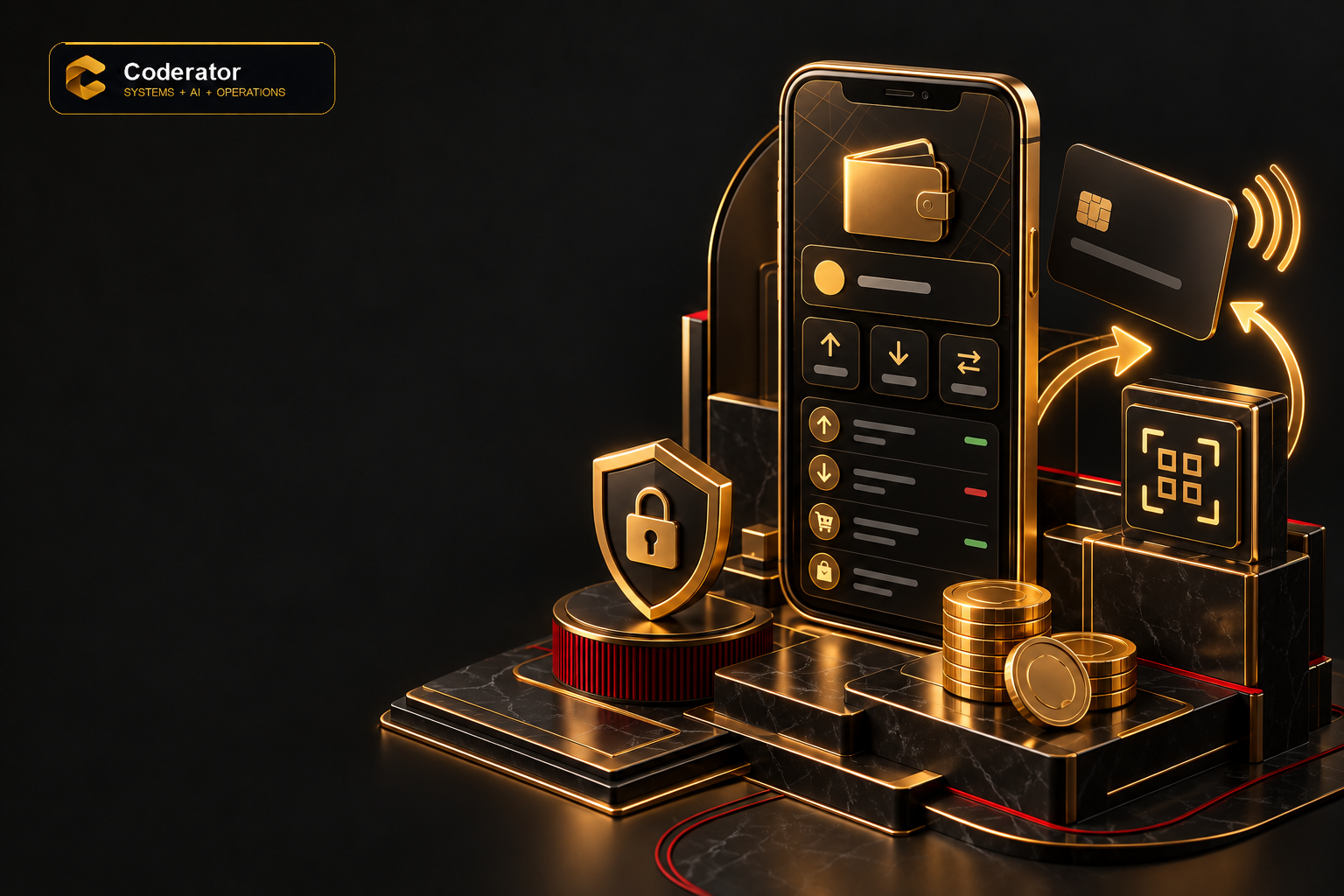
Building a digital wallet or e-payment app is an appealing idea in a rapidly growing digital financial market, but it’s one of the most difficult and sensitive technical projects imaginable—and for a reason that many entrepreneurs don’t realize until they run into it. You’re not just building an app that displays products or schedules appointments; you’re building a system that handles people’s real money and their trust, all under the strict oversight of the central bank. The first thing you need to know before writing a single line of code: the financial sector is licensed and regulated, and no one can simply build a “wallet,” launch it, and hold people’s money the way they would build an online store—it requires licenses, often a partnership with a bank or a licensed financial services provider, and adherence to strict security and compliance standards. Anyone who sells you a “wallet app” without being upfront about this is selling you a project that may be non-compliant or impossible to operate. The success of a payment app doesn’t start with the user interface; it starts with understanding the regulatory framework, security, and compliance—these are the product itself, not just add-ons.
In this guide, we provide you with what you really need to know before making any decision: why licensing and regulation should be your first consideration, what types of payment apps exist, why security and compliance (KYC/AML) are the product itself, how it integrates with banks and infrastructure, how it combats fraud using artificial intelligence—and how we build all of this responsibly at Coderator.
1. Who is Coderator? And why do we build FinTech applications responsibly?
Coderator is a software company specializing in building advanced business systems and integrating artificial intelligence into real-world operating environments. We operate from our offices in Giza and Riyadh to serve companies in the Middle East and North Africa. We treat payment apps as sensitive financial systems that handle people’s money and trust under regulatory oversight—not just as apps. That’s why we don’t start with screens; we start with the questions that protect your project: What regulatory framework governs your idea? Do you need a license or a partnership with a licensed entity? How do we build security and compliance into the very core of the system? Then we build a secure, compliant, and scalable app. And we’ll be completely honest with you: if your idea requires a license you don’t have, we’ll guide you down the right path (a partnership with a bank or a licensed provider) rather than build a non-compliant project for you. Most importantly: the code and your data are entirely yours—which is crucial in an industry built on financial trust.
2. Licensing and Regulation: The First Thing You Should Think About (Not Screens)
This is the most important section of the entire guide, and what you must understand before spending a single pound on development. The financial sector is one of the most heavily regulated sectors in the world, and Egypt is no exception: The Central Bank of Egypt governs payment services and digital wallets with strict laws to protect people’s funds and the financial system. This means you can’t simply build an app that holds and transfers users’ funds the same way you’d build any other app. Depending on your business model, you may need a license from the Central Bank, or—as is most common for startups— — a partnership with a bank, financial institution, or licensed payment service provider under whose umbrella your app operates, with them handling the licensing side while you build the technical layer and user experience.
This reality completely changes your priorities: before thinking about design and features, you must decide how you’ll operate legally. Building a great app only to discover you can’t legally operate it is a disaster that wastes your entire investment. That’s why we always start with this question and are completely honest with you: Some ideas require a lengthy regulatory process, while others can be launched quickly through a partnership with a licensed provider or by using existing payment gateways (such as licensed local payment gateways) instead of building a complete wallet from scratch. Anyone who sells you a wallet app without discussing licensing either doesn’t understand the industry or is hiding the most critical part from you. We guide you down the right path first, because a financial project built on the wrong legal foundation is doomed to fail, no matter how beautiful the app may be.
3. Which FinTech model are you adopting? (The model determines everything)
“Payment app” is an umbrella term that encompasses radically different models, each with its own regulatory and technical requirements. Defining your model determines your entire path:
The regulatory differences between these models are significant: a closed-loop wallet (in-store credit) may not require a financial license, while an open-loop wallet that transfers funds externally requires a full regulatory framework. We’ll start by working with you to precisely define your model and its regulatory requirements, because this determines whether your project needs a license, a partnership, or can be launched quickly—and that’s the most important decision before you begin building.
4. Security and Compliance (KYC/AML) Are Not Just Features—They Are the Product
In payment apps, security and compliance aren’t just added features—they’re the core of the product and a prerequisite for its existence. Users entrust you with their money, and regulators monitor every transaction; any security vulnerability or compliance breach could result in the loss of funds and trust—and possibly legal shutdown. We build this system into the very core of the app:
- User Identity Verification (Know Your Customer): ID card, photo, and mandatory verification before activation.
- Tiered verification levels based on transaction limits (the higher the limits, the more verification is required).
- Automated document verification and secure linking to the user, in compliance with regulatory requirements.
- Anti-Money Laundering (AML): Transaction monitoring, detection of suspicious patterns, and reporting.
- Full encryption of data and transactions, and multi-factor authentication (PIN, fingerprint, facial recognition).
- Regulatory transaction limits and controls, and a complete audit trail for every transaction for accountability and auditing.
- Protection against fraud and unauthorized access, with monitoring of unusual devices and locations.
Compliance (KYC/AML) is not a bureaucratic burden but a legal requirement that cannot be bypassed—and it protects both you and your users. A payment app without strict compliance is an illegal operation at risk of shutdown, and without robust security, it’s a disaster waiting to happen. We build security and compliance into the foundation of the system, not as an afterthought, because in the financial sector, they are the true foundation upon which both user and regulatory trust are built.
5. The Core Wallet and Its Features
After securing the regulatory and security framework, we build the wallet features that customers use daily, with a seamless experience that hides the complexity behind it. Core functions: Top-up (from a card, bank account, or top-up points), payment (scan a QR code, pay a merchant, or make online payments), transfer (to another user via phone number or account), and balance withdrawal (to a bank account or cash-out location), and a clear and transparent transaction history. We also add features that enhance value: bill and service payments (electricity, water, cell phone, internet), card linking, and instant notifications for every transaction (essential for trust and security—the user is immediately notified of any activity on their balance).
The app’s unique feature here is that the phone’s capabilities facilitate direct payments: Scan a QR code with the camera for instant payment, real-time notifications for every transaction (for peace of mind and security), biometric authentication (fingerprint/face) for quick security, and contactless payment (NFC) where available. We build features to be simple, fast, and secure all at once, because users want both speed and trust in their financial transactions—and we hide the security and regulatory complexities behind a simple experience they can trust.
6. Integration with Banks and Financial Infrastructure
A payment app does not operate in isolation; rather, it integrates with an entire financial ecosystem, and this integration is at the core of its operation. We build the integrations necessary for your model: connecting to locally licensed payment gateways (which enable the legal and secure acceptance of payments and cards), integrating with banks and bank accounts for deposits and withdrawals, connections to real-time transfer networks and the national payments infrastructure (which enable instant transfers between financial institutions), and integration with existing mobile wallets and service providers (for bill payments and top-ups).
These integrations are complex and sensitive because they involve real money and are subject to strict security standards and technical specifications from all parties. Building them correctly requires expertise in dealing with financial systems and their security protocols. Proper integration is what makes your app an effective part of the financial ecosystem rather than an isolated island, enabling users to top up their wallets, transfer funds, and make payments anywhere. We build these integrations with precision and security because they are the lifeblood of your financial app; any flaw in them means a failed transaction or lost funds—both of which are disastrous in an industry built on trust.
7. User Experience and Trust
In financial apps, the user experience poses a unique challenge: you must balance simplicity and speed on one hand, and security and reassurance on the other. Users want fast payments with as few steps as possible, but they also want to feel that their money is safe. We build an experience that achieves both: a simple, clear interface that completes the transaction in as few steps as possible, with visible trust cues (confirmations, instant notifications, transparency regarding fees and balances). Trust is built through the details: an instant notification for every transaction reassures the user, complete transparency regarding fees (no hidden fees to undermine trust), a clear transaction history, prompt support for any financial issue (where anxiety is highest), and a professional design that conveys security and reliability (users won’t trust their money to an app that looks cheap).
Trust in a financial app is more valuable than any feature, and it is built slowly but destroyed quickly: a single error in a transaction, a hidden fee, or a delay in resolving a financial issue could cause you to lose a user forever—and prompt them to warn others. That’s why we design every detail to build trust and reassure users that their money is in safe hands, while keeping the experience simple and fast. Striking the balance between ease of use, security, and trust is the art of financial app design, and we’ve mastered it because it’s what sets apart a payment app that people use with confidence from one they avoid out of fear for their money.
8. Dashboard and Revenue Model
Behind the app is a control panel that manages the financial system and ensures compliance. We build it with specifications that take into account the sensitivity of the sector: user management, identity verification (KYC), and user approval; transaction monitoring and detection of suspicious activity (AML); management of limits, fees, and regulatory controls; accurate financial reports and compliance reports for regulatory bodies; management of disputes and disputed transactions; precise permissions; and a complete audit trail for every operation (essential for accountability in the financial sector).
The revenue model in FinTech is multifaceted: transaction fees (a small percentage of each transfer or payment), service fees (bill payments, withdrawals), subscriptions for merchants or advanced features, commissions from partners (service providers), and—in installment models—interest or financing fees. We design a revenue model that is appropriate and compliant with regulations. We tailor the dashboard and revenue model to your specific needs, keeping in mind that transparency and compliance in fees and reporting are regulatory requirements, not optional.
9. Combating Fraud with Artificial Intelligence
This is our true focus; AI in FinTech is not a luxury but an essential protective shield, because payment apps are a constant target for fraudsters:
We’ve added a feature that effectively protects your users’ funds and your system, while ensuring the highest levels of privacy—financial transaction data is highly sensitive and is not leaked to public training models. AI-powered fraud detection is one of the key features that sets a serious payment app apart, because fraud is the number one threat in the industry, and a system that monitors it in real time protects everyone’s funds and trust.
10. Technical Architecture and Scalability
Payment apps require top-tier technical infrastructure, because any outage or slowdown means failed transactions, frozen funds, and lost trust. We build a robust infrastructure: high reliability (a financial app cannot afford downtime—users need access to their funds at all times), scalability that accommodates growth in users and transactions without compromising performance, absolute accuracy in transactions (not a single error is acceptable in a financial calculation—every penny counts), disaster recovery and backups that ensure no financial data is lost, and fast performance (users cannot tolerate delays in financial transactions).
These requirements are far higher than those of any ordinary application, because errors involving money are not as easily forgiven as they are in an application that displays products. Transaction accuracy, in particular, is critical: the system must ensure that every transaction is either fully executed or not executed at all—so that funds are not deducted from one account without being added to another. We build the architecture to these strict standards because a payment app handles people’s money, and reliability and accuracy are not mere improvements but prerequisites—a financial app that loses a transaction or crashes when needed loses its users’ trust immediately and forever.
11. From scratch or based on a licensed framework?
Here, we’ll be completely honest with you about the most important strategic decision for your financial project:
- Building on a licensed provider’s infrastructure is often the smartest way to start: Instead of building a licensed wallet from scratch (a long, costly, and regulatory-wise complex process), build your app and user experience on top of a licensed payment gateway or financial services provider that handles the regulatory side, allowing you to launch faster and with greater legal certainty.
- A more in-depth approach (special license) is best suited for large or well-funded organizations that want a complete financial ecosystem they own and are willing to undertake the lengthy licensing process and its costs, or those with an existing banking partnership.
We won’t push you toward a complex licensing process if building on a licensed provider achieves your goal faster and more securely—in fact, we often recommend this approach to get started. We’ll be honest with you if your idea requires something you don’t have from a regulatory standpoint, and we’ll guide you toward a realistic path. We build the technical infrastructure, user experience, and security to the highest standards on top of the correct regulatory framework for your project, because your financial success starts with a sound legal foundation. We’ll help you make the right decision with complete honesty—because a financial venture built on the wrong path is a guaranteed loss.
12. Cost and Methodology
The cost of a payment application varies significantly depending on its model and regulatory requirements, the level of security and compliance, the scope of integrations (banks, gateways, networks), AI components, and infrastructure. It is one of the most complex and sensitive technical projects, so it is not appropriate to provide a final figure before understanding your model and its regulatory framework; anyone who gives you an immediate price without a thorough analysis does not understand the complexity of the sector. We start with a discovery session to understand your idea, model, and regulatory requirements, and guide you toward the right path (licensing or a provider partnership), then develop a clear roadmap for the scope, cost, and phases.
Our methodology takes into account the extreme sensitivity of the financial sector: a discovery session where we first define the regulatory framework (the most important step), then design an experience that balances ease of use and security, then we build security and compliance (KYC/AML) into the core of the system, develop features and integrations with precision and strict financial standards, conduct intensive security testing (essential in finance) before launch, and finally ensure a managed launch and ongoing support. We build a secure, compliant, and reliable app that your users and regulators can trust, because that is the only way to succeed in an industry built on trust and compliance.